


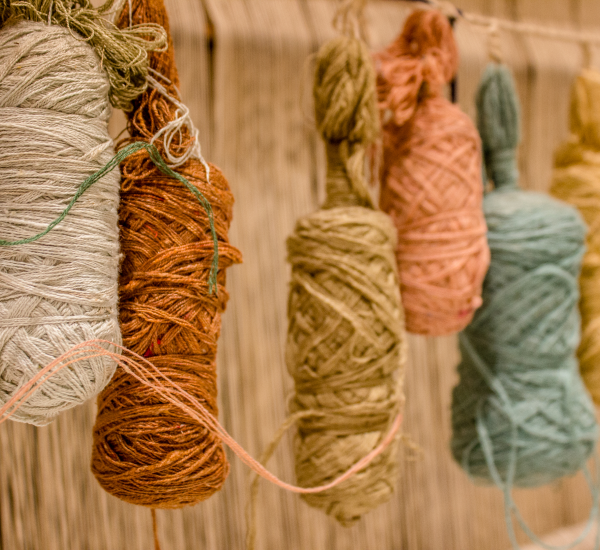

At Beyond Basic Home, we believe that age-old craft traditions are a part of our cultural heritage, meant to be cherished, preserved, and celebrated. Yet, we also recognize the need to reinterpret them for modern living.
With this vision, we collaborate with Kashmiri artisans to bring the valley’s timeless artistry into contemporary homes.
From cushion covers and runners to dinner napkins, each piece is meticulously hand-embroidered on fine textiles, transforming simple fabric into something truly enduring. Every creation is a limited-edition statement piece, shaped through months of patient craftsmanship, from selecting the perfect base to stretching, embroidering, and layering stitches until the design comes to life.
Our artisans come from the rural villages of the Kashmir Valley, carrying with them generations of mastery in embroidery. Each artisan holds deep expertise in a specific technique, whether aari, crewel, tilla, zari, or sozni, skills passed down through time, perfected by hand, and preserved with pride.
Fabric Preparation
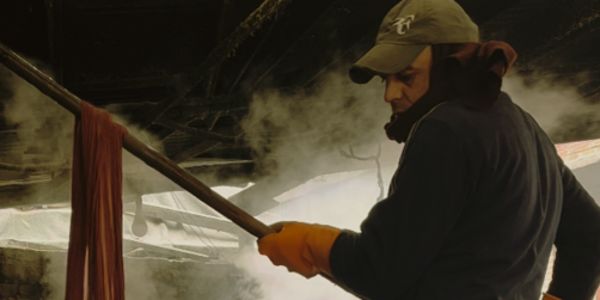
Before the design is transferred, the fabric undergoes a sanforization (pre-shrinking) process, an essential step that ensures durability and stability. During this stage, the fabric is dyed and pre-washed, then gently moistened with steam or water to relax its fibers. It is then passed through rubber belts and heated rollers, which stretch and compress the material under controlled pressure. This process stabilizes the weave, enhances texture and softness, and ensures that the fabric will not shrink or distort after washing, maintaining consistent quality across every piece.
Tracing & Hand Embroidery
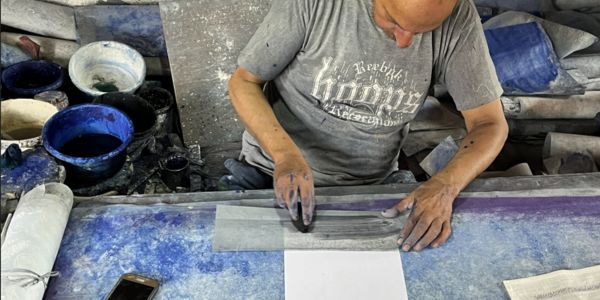
Once the fabric is prepped, the design blueprint is traced onto it and passed on to a group of karigars who bring it to life through hand embroidery. Depending on the chosen technique, the fabric is carefully distributed among artisans who specialize in crewèl, aari, zari, tilla or other traditional forms of embroidery.
Craftsmanship & Technique
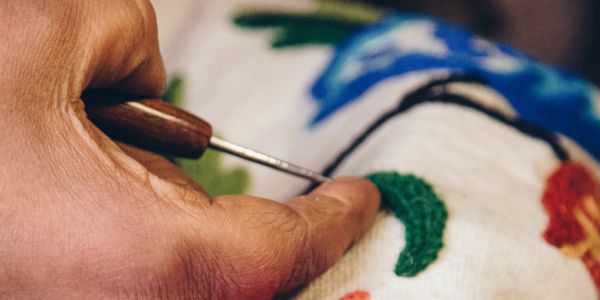
The intricate process of creating crewel or aari embroidery begins with artisans weaving their stitches carefully over the hand-traced design. While both techniques resemble chain stitch, they differ in materials, motifs, and texture. Traditionally, crewel embroidery is crafted on thicker fabrics such as wool (khaddar) using a hook-like needle and 2- or 3-ply woollen yarn, making it ideal for winter furnishings like curtains and bedding. Over time, this heritage technique has evolved; today, it is also practiced on velvet, organza, and cotton, bringing versatility and a modern sensibility to this age-old craft.
Finishing Touches
The entire process concludes with a final wash to remove the blueprint markings and a careful ironing to smooth out the fabric, revealing a beautifully raised, dimensional texture that feels as rich as it looks. In select cases, such as dinner napkins, the embroidered fabric undergoes an additional wash and roll-press finish before being sent to the stitching unit for final construction.
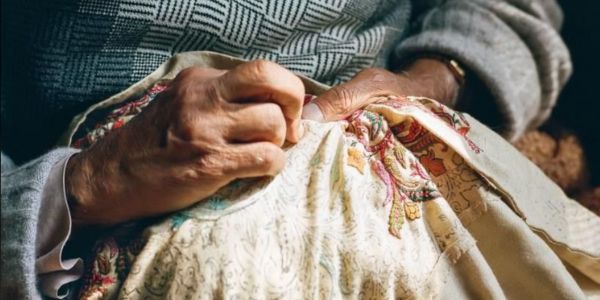
Each step in the making of a Beyond Basic Home piece reflects a journey of time, touch, and tradition. From the careful selection of designs to the precision of hand embroidery and the final finishing, every process is shaped by patience and purpose. What begins as a simple fabric transforms through many skilled hands into something timeless – a piece that carries the story of craftsmanship from the valley of Kashmir to homes that value beauty made with heart.